2026 Toyota Grand Highlander vs. 2026 Hyundai Palisade: Car Seat Comparison
Skye Delax
February 15th, 2026
No Comments
The Highlander has long been a staple in the three-row SUV segment, but Toyota recently expanded its lineup with the more spacious Grand Highlander. While it shares powertrain options with the standard Highlander, the Grand Highlander offers more interior space, making it ideal for families with car seats. We recently compared the Toyota Grand Highlander with one of the segment’s frontrunners, the Hyundai Palisade. We found that, despite its increased size, the Grand Highlander might not be the best option for people with car seats on board.
Legroom Matters – Sort of
The base 2026 Toyota Grand Highlander XLE’s interior dimensions measure:
Front legroom: 41.7 in.
Second-row legroom: 39.5 in.
Third-row legroom: 33.5 in.
That compares with the base 2026 Hyundai Palisade (gas) SE’s measurements of:
Front legroom: 44.2 in.
Second-row legroom: 43.0 in.
Third-row legroom: 32.1 in.
The Grand Highlander’s wheelbase extends four inches longer than the standard model’s, giving it more space inside, but it fails to match the Palisade’s impressive specs. Hyundai buyers see more legroom in the first two rows and only 1.4 inches less in the third row than the Grand Highlander.
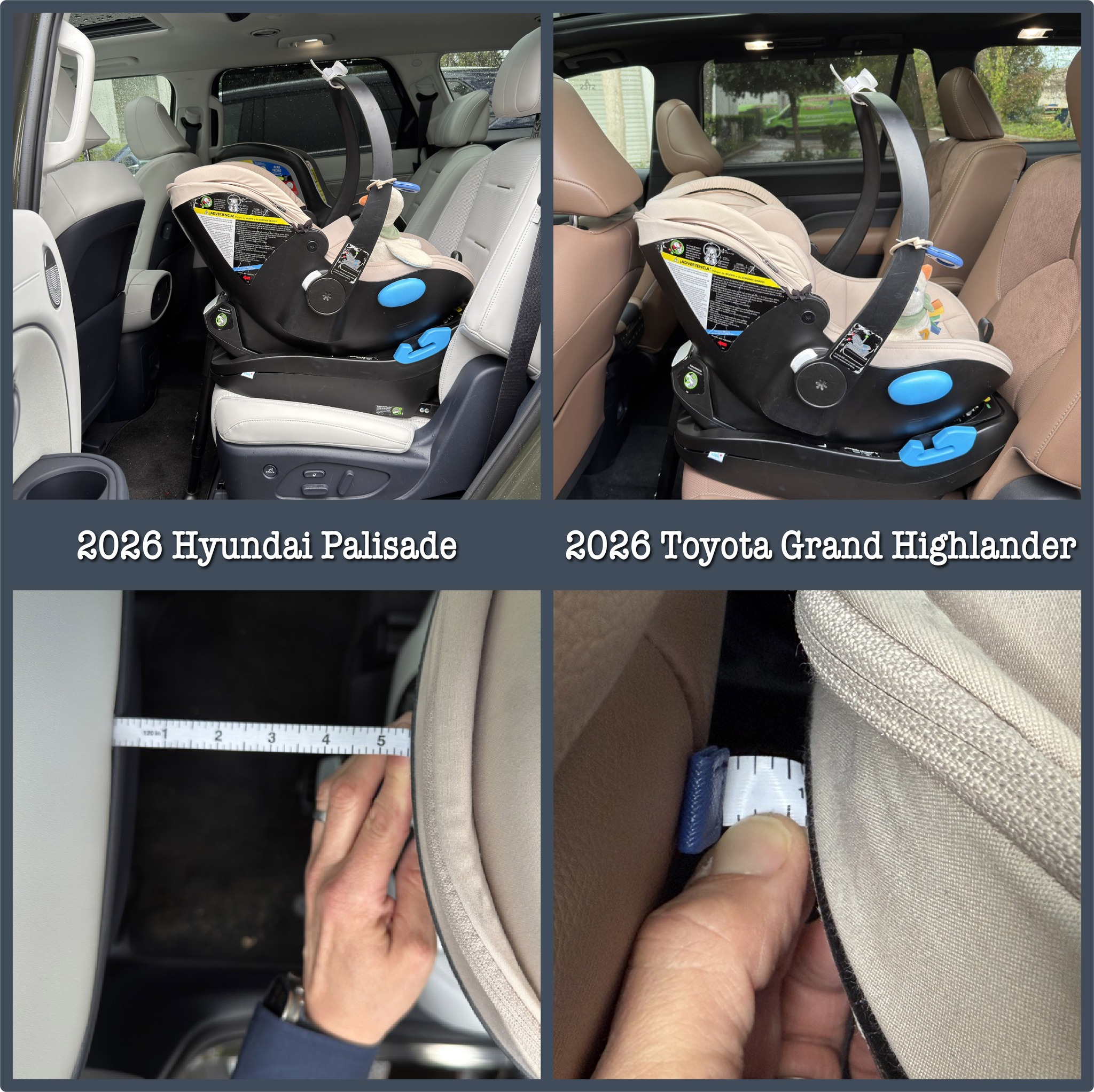
Even so, those numbers make both SUVs look great on paper, but in practice, the Toyota’s second row feels a lot less spacious with taller adults in the front seat. With our legroom measurements, which came to 118.8 inches total across all three rows (more generous than Toyota’s specs), an 80th-percentile male adult’s seat adjustments make it difficult to install and use a rear-facing seat in the second row. While it’s still possible to make it work, thereis very little space between the front seatback and the child seat. If you’ve ever tried lifting a loaded seat into an SUV, you’ll understand the value of having extra space between the first and second rows.
The Palisade’s second row is much more accommodating. With the front seat adjusted for a same-size adult male, our rear-facing car seat had 5 inches of clearance from the front seatback. Additionally, the Hyundai’s second row is two inches wider door-to-door, and with captain’s chairs, the buckets are two inches wider than the Grand Highlander’s.
More space in the Hyundai’s second row opens more seating possibilities for older children and adults. The second-row seats slide, allowing more legroom in the third row when a car seat is installed in the middle. Wider bucket seats mean there’s more room to access the third-row seat, and the “wayback” seats also slide, enabling more cargo space when all three rows are in use.
All of that sounds great, but what about being able to lift a seat into the vehicle? The Toyota Grand Highlander offers eight inches of ground clearance compared to the Palisade’s 7.4 inches. Those numbers matter if you’re taking your three-row SUV off-road, but you likely won’t, meaning you have more than half an inch of additional lift height to load a child and a car seat into the vehicle. That might not sound like much, but the extra 0.6 inches can become a problem as your child grows and the combined weight of the car seat and your child starts to feel like a deadlift.
One area where the Toyota excels is third-row legroom, but the Grand Highlander’s back seat doesn’t slide. In theory, that isn’t a huge problem, as the third row is generally reserved for overflow seating and most people aren’t riding back there on longer trips. In practice, the Palisade’s sliding third row is a significant benefit when you need six or seven seats and usable cargo space, as long as the people stuck in the last row aren’t super tall.
Headroom Plays a Role
The Grand Highlander offers 39.4 inches of second-row headroom and 36.1 inches in the third row. The Palisade is more spacious, with 40.7 inches of second-row legroom and 37.8 inches of third-row legroom. Again, those don’t sound like huge differences, but they do make it easier to load a rear-facing seat into its base or to secure a child into a front-facing seat. Both SUVs have reasonably sized door openings, but the extra inch-plus of headroom means you’ll be less likely to jostle your child or scrape a knuckle trying to get them into the car. It also makes it much easier to load the seat into the vehicle using the handle, rather than folding it down and maneuvering it in by its edges.
Think About LATCH
We install and uninstall car seats and their bases in dozens of vehicles every year, but you probably (hopefully) won’t be that busy with your kid’s seat. Even so, it’s important to assess how easy it is to install a seat, including testing the LATCH car seat anchors in each vehicle. The Insurance Institute for Highway Safety awarded the 2026 Hyundai Palisade its highest Good+ overall score, thanks to the ease of use of the second-row LATCH. The organization noted that the anchors are easy to find and not too deep in the seat. The Hyundai also has plenty of space around each anchor, making it easy to anchor the seat hooks without too much force. The third row outboard seats earned an Acceptable score due to the harder-to-reach anchor points.
The Toyota Grand Highlander earned a Good score, with similar notes for its second-row anchor points. In the third row, the driver-side outboard seat lacks anchor points and was not scored, but the passenger-side seat hardware was easily mistaken for LATCH anchor points, earning it a Marginal score and slightly dragging the overall score down compared to the Hyundai.
Our experience showed that the Hyundai Palisade will likely be a better choice for buyers with children in car seats, but that doesn’t mean it’s the best option for every situation or buyer. Don’t be afraid to take your car seats to the dealer to test each vehicle for yourself. Every seat, child, and buyer is different, so you may find that the Toyota makes loading and unloading easier with your car seat model.
Car buyers love the appearance of legitimate off-road capabilities, even if the roughest terrain they’ll ever tackle comes in the school drop-off line. That’s why we see “soft-road” SUVs from…
Hyundai will reportedly halt production of the compact Santa Cruz pickup truck due to slow sales after just a few years on the market. The South Korean automaker is expected…
In this episode of the Auto Buyer’s Guide, Alex and Travis take a deep, data-driven dive into 2025 U.S. auto sales for the manufacturers that have reported so far. They…
Contact us for a review suggestion. Please note that due to the volume of submissions it’s not possible for us to reply to questions or other feedback.