The Extended-Wheelbase Tesla Model Y L Can Now Be Reserved
The previously China-only Model Y L will reach American buyers by October 2026.



Genesis has grown into a real menace for European luxury brands, offering a range of upscale, nice-to-drive vehicles that deliver real value against many higher-priced competitors. That said, the popular Genesis GV70 outprices the segment-standard BMW X3 in many configurations. However, it differs from the German SUV in attitude and feel, with the X3 offering a sportier feel and driving experience. We’ve compared the two across a few key categories to give you an idea of where they stand. Here’s how they stack up.
The base Genesis GV70 2.5T starts at $48,985 before destination. Stepping up to the Select trim pushes the price to $51,885, and the 2.5T Advanced costs $56,435. The top 2.5T Sport Prestige runs $59,795 – a steep ask for a four-cylinder-powered SUV. Two V6 trims are available: the $64,415 3.5T Sport Advanced and the $71,095 3.5T Sport Prestige.
BMW charges $51,300 for the entry-level X3 and $66,500 for the powerful M50 model. While cheaper than the GV70 in many configurations, BMW charges extra for many options Genesis includes as standard, making it easy to drive the price tag upward in a hurry.
Genesis offers two powertrain options for the 2026 GV70. The base configuration includes a turbocharged 2.5-liter four-cylinder engine that produces 300 horsepower and 311 pound-feet of torque. A twin-turbocharged 3.5-liter V6 is available, which offers a much healthier 375 horsepower and 391 pound-feet of torque. Both engines pair with an eight-speed automatic transmission, and all-wheel drive is now standard. While it might be tempting to spring for the more powerful and much more expensive V6 engine, the base turbo-four is surprisingly solid. It offers strong acceleration and good off-the-line torque, and it works well with the all-wheel drive system to put that power down.
That said, the twin-turbo V6 is surprisingly stout, making the GV70 feel livelier and more muscular in all situations. It builds power smoothly, delivering quick but predictable acceleration, and there’s a healthy sound to go along with it. The eight-speed automatic isn’t the most responsive transmission around, but it offers rapid shifts and works well with the larger engine, helping the SUV achieve a 0-60 mph time of around five seconds.
The base BMW X3’s turbocharged 2.0-liter four-cylinder makes 255 horsepower and 295 pound-feet of torque. It’s also mated to an eight-speed automatic transmission and standard all-wheel drive. While down on power compared to the GV70’s turbo-four, BMW did a good job tuning the engine to deliver lively acceleration, and the throttle’s responsiveness helps make the SUV feel quick. The automaker quotes a 0-60 mph time of 6 seconds for the base four-cylinder.
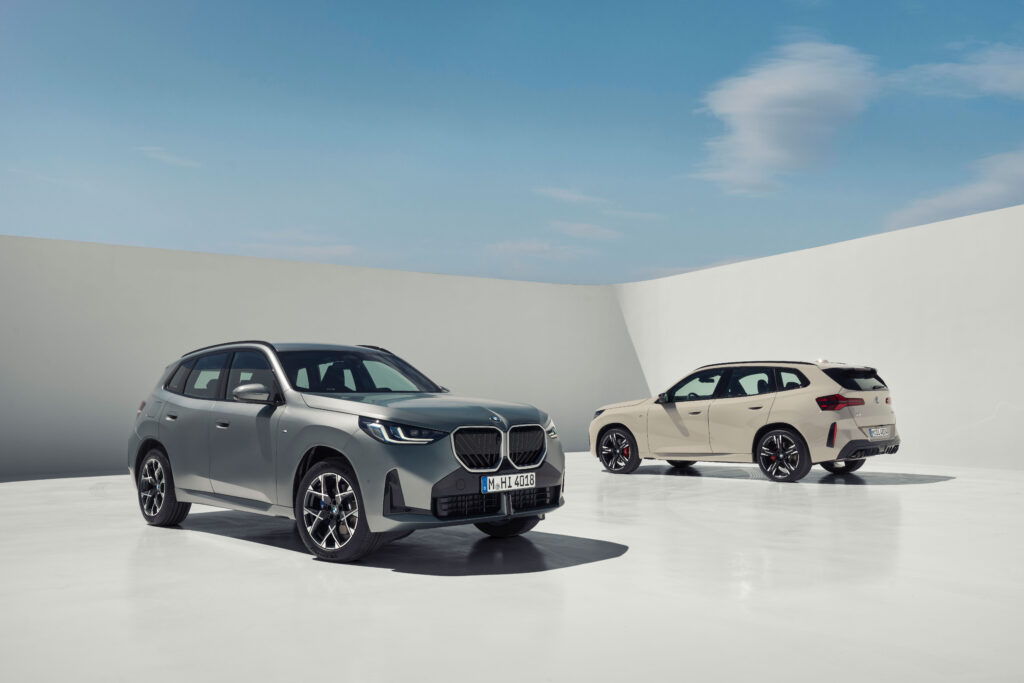
Stepping up to the X3 M50 xDrive brings a turbocharged 3.0-liter inline-six-cylinder engine that delivers 393 horsepower and a whopping 428 pound-feet of torque. BMW uses this six-cylinder engine in a range of vehicles for good reason: It’s impressively powerful, reliable, and responsive. While this isn’t a full-fat M-powered SUV, the M50 is capable of a 4.0-second 0-60 mph time, aided by the quick-shifting eight-speed automatic transmission and all-wheel drive.
The BMW wins on acceleration and sportiness, and the up-level M50 model is priced competitively with the V6-powered Genesis GV60. In some cases, it’s easy to write off the German SUV due to a wide price gap, but that’s not the case here. However, the GV60 offers other charms, including its opulent interior.
Genesis equips synthetic leather upholstery on the two lowest trims, while the Advanced and Sport configurations feature genuine leather. A power driver’s seat and heated front seats are standard, with available ventilated front seats and an optional power passenger seat. The GV70’s interior is gorgeous across all trim levels, with quilted upholstery and nice finishes throughout the cabin. While lower trims lack genuine leather, the synthetic upholstery looks nice enough, and it feels more expensive than the materials used in competing models.
All GV70s come with a 27-inch OLED display screen that offers wireless Apple CarPlay and Android Auto, SiriusXM radio, HD radio, and cloud-connected apps. Over-the-air updates are also standard. Higher trims add a 16-speaker Bang & Olufsen stereo. Despite more flash than its parent company, Hyundai’s interface, Genesis’ infotainment system is straightforward to use. It has a good amount of processing power, making it feel snappy and responsive, and the layout is easy to understand.
The base X3 30 xDrive also comes standard with synthetic leather, along with heated front seats, power adjustments, four-way lumbar support, and more. While it’s not as intricately designed as the GV70’s interior, the X3 feels upscale, and it’s nice enough for the price. BMW offers multiple colors, and extended Merino leather upholstery is available. Ventilated front seats are also available.
BMW equips a 14.9-inch touchscreen and a 12.3-inch digital gauge cluster running its latest iDrive 9 infotainment system. The interface offers touch and voice controls, and it retains an iDrive controller knob for quick settings changes. BMW’s infotainment system is more complex than the Genesis setup, offering multiple customization options and a somewhat convoluted menu system. That said, it’s extremely responsive and comes with a range of desirable features, including 5G connectivity, SiriusXM radio, over-the-air software updates, Apple CarPlay and Android Auto, BMW remote services, and Bluetooth. Wireless phone charging is also standard.
While the Genesis GV70 and BMW X3 have similar pricing, they take different approaches to the luxury SUV formula. The GV70 is certainly quick enough, especially with the available V6 engine, but it’s obvious Genesis aimed for a more luxurious feel. It’s a bit softer than the BMW, and the interior feels more opulent and comfortable. The GV70 is also more stylish than the X3, which further leans into the luxurious vibe.
The BMW X3 is noticeably sharper in almost all aspects. It has a sportier ride quality and better handling, which offers a more thrilling driving experience, but it can be a bit harsh on rougher road surfaces. The M50 trim takes that feel even further, but it’s also significantly quicker than the twin-turbo GV70. While it’s not as flashy as the Genesis, the X3 is a handsome SUV, and it’s just muscular enough to communicate its performance.







Dan says:
I would have like an audio comparison and how the exhaust sounds in each, thanks.